

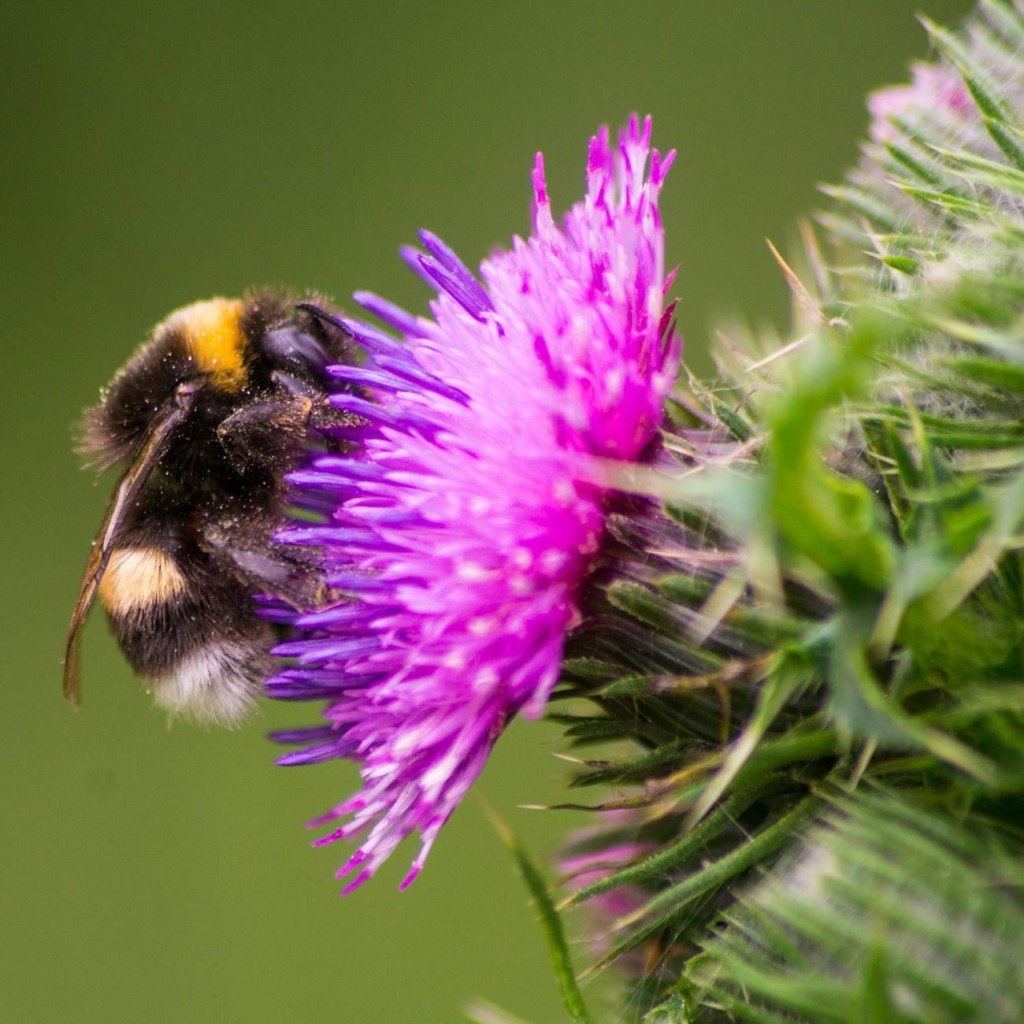
Bees and bumblebees are both pollinators, and they look a little different.
When we consider pollinators, many just think bees. Yet, the pollinator family is any insect that visits your flowers, be is wasps, ants, bees, bumblebees, butterflies, moths, and yes, even hummingbirds!
To be a pollinator, you must carry pollen from one flower to another. Even people do this when they hand pollinate squashes for example.

Bees are definitely hard workers, they pollinate flowers by transporting pollen on their abdomen from one flower to another, they produce and use their own honey that they make out of the pollen for energy and nutrients and they take the pollen and excess honey back to their hive as food and storage for winter.
- There are over 20,000 varieties of bees worldwide. In North America, we have a collection of about 4,000 native species of bees.
- Bees produce honey and collect the excess honey that they do not use in their hive
- Bees are out mostly on sunny days, meaning there is not as much pollination on cloudy days.
- Bees have a stinger and once they use their stinger, they die. If you get stung, never pinch the stinger, but rather just swipe the stinger out with a credit card or something with an edge. Bees are not really aggressive unless you threaten them. Never swat at bees or at any insect for that matter because this encourages stings by these insects. Instead, let them get used to you, let them get to know you as part of their environment. I am at a point right now where pollinators recognize me, several come and check me out as if they are saying hello when I am working in the garden or when I am sitting on my deck.
- Bees will be more aggressive when food sources are scarce, such as early spring. So this is another reason why it is a great idea to make sure you do not mow till after May. White clover is a beautiful permanent ground cover and bees and bumblebees will love it! You could consider growing a clover yard! You will not need to mow it, though I would encourage you to use stepping stones, on frequent paths in your yard so that you do not accidentally get stung by pollinators that are tending to your clover field.
- Not all bees are pollinators. For example, the cuckoo bee raids the reserves of hives by laying eggs inside the hive snd these cuckoo larvae will then deplete the reserves, and this can kill colonies.
- Did you know that a single average sized colony of bees can collect about 40 pounds of pollen annually?
- Bees do not have much of a preference for particular flowers or plants, if it has pollen, they are on it!

Bumblebees are a bit different from honeybees.
- There are about 46 species of bumblebees in North America, 250 species worldwide.
- Bumblebees colonize in much smaller groups. They are a colony of a few hundred, whereas the bees colonize by the thousands.
- Bumblebees create their nest in an old rodent burrow underground or even in a clump of grass on top of the soil.
- Bumblebees will pollinate your flowers even when it is cloudy, and tend to be better suited in situations where challenges with pollinators exist due to environment. They are a preferred pollinator to greenhouse farms.
- Bumblebees do product honey but not in quantities that creates reserves like honeybees do. The honey that bumblebees create is for their own consumption.
- Bumblebees have a more erratic flight pattern than bees, bees are very targeted with their swift flights from flower to flower where bumblebees are less targeted.
- A bumblebee can sting repeatedly because they have a smooth stinger, whereas the bee has a barbed one that they lose. Even though they can sting, it is rare. Bumblebees are not aggressive.
- One lookalike bumblebee is a carpenter bee, this dude is one you generally do not want around your house. They are a bit of a stalker, because they look at you and hover in front of you. These guys create their nests in wood by drilling holes into the wood. You will want to treat these nesting sites!
As a final note, I would like to request that you limit use of broad spectrum insecticides. The reason for this is because the extensive use of insecticides causes a disruption in the ecological balance of nature, and thus bees are dying as are other beneficial insects such as lacewings. This has as result that these insecticides are creating a situation where our food supply will diminish if we keep killing bugs using these broad spectrum sprays and granules. While I agree with control of Japanese beetles, grubs, mosquitos and ticks, please use either organic control or selective control that solely targets these types of insects. BT, which is made from Chrysanthemums is an excellent pesticide to use directly on vegetation to prevent caterpillars from eating your crops, diatomaceous earth works well for anything from snails, to ants and anything that has an exoskeleton but should be used when it is not windy outside. Neem oil is another product that can be used for insect pests on plants but should be used at night when the bees have gone to sleep already because direct application to bees will harm them.
Remember the more pollinators, the more flowers, the more flowers, the more produce! Plant wildflowers in a designated section of your yard so the pollinators can have their home there, and they will not bother you on your deck. Adding a shallow dish with clean fresh water, and a small branch or rock for insects to come and get a drink is also a really good idea to include with your wildflower garden.
 Inga’s Creations