

Sourdough starter is a super old leavening agent to make perfect artisan breads. Early evidence was found in Egypt in clay jars that are said to be from around 3700 BC.
Sourdough starter eliminates the need for sugar and processed yeast. The fermentation process of flour such as whole wheat, rye, or unbleached bread flour creates carbon dioxide which creates bubbles and it acts as a leavening agent to produce delicious breads.
Below I will describe the process that I am following to create sourdough starter.

Day 1
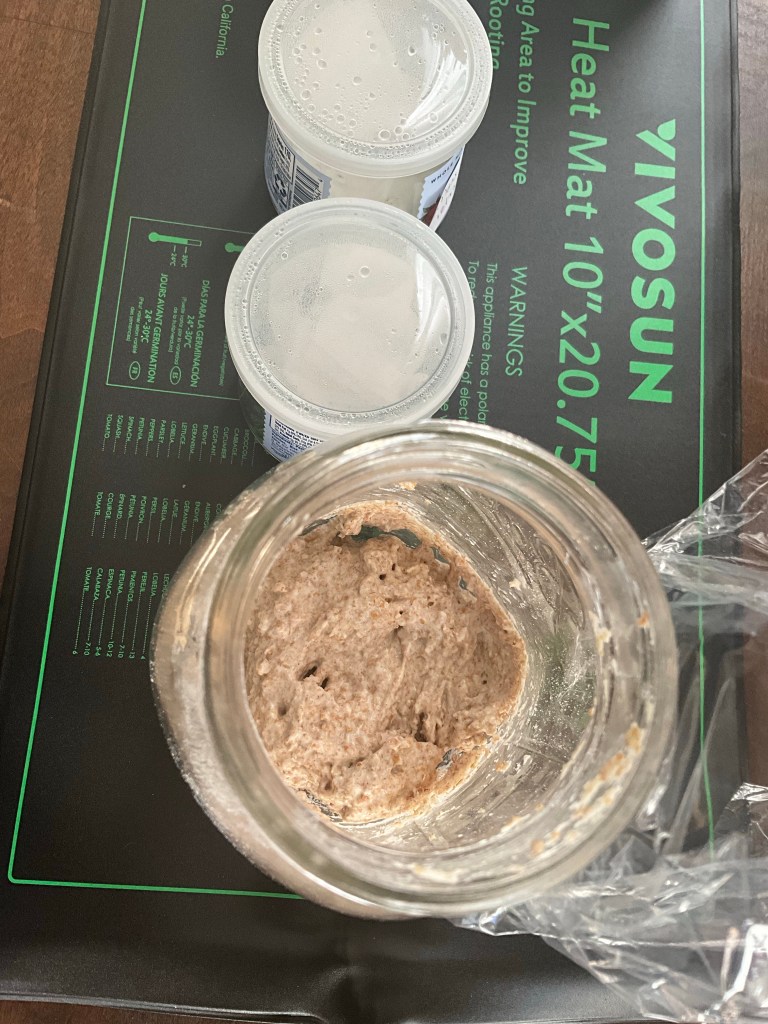
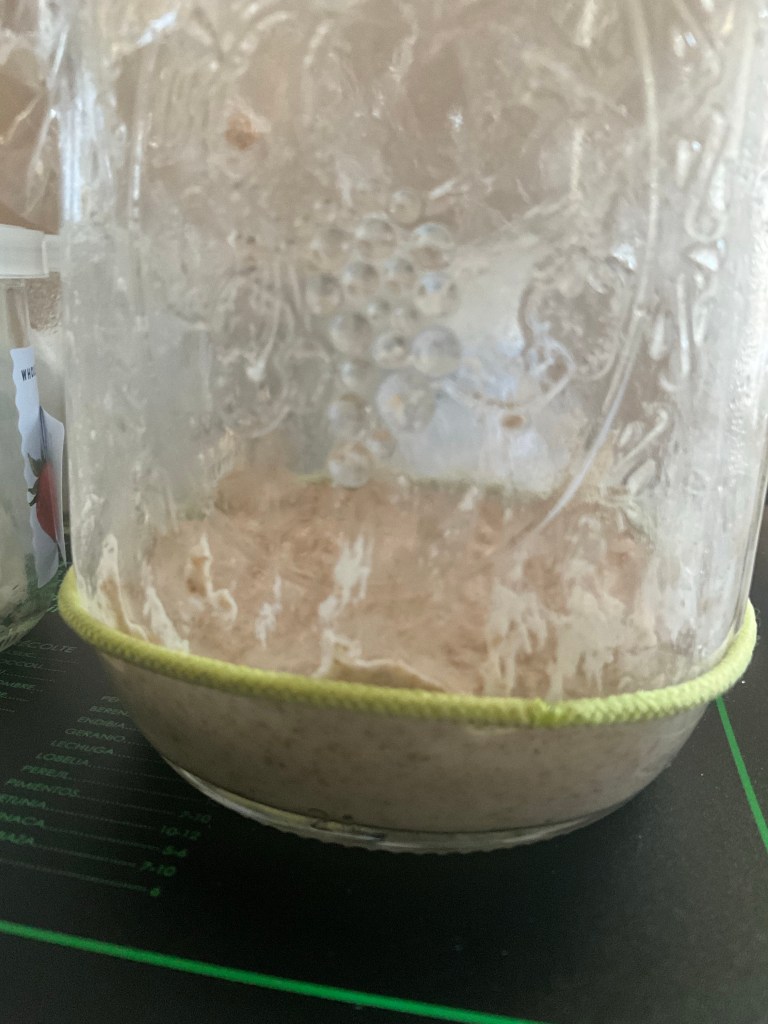
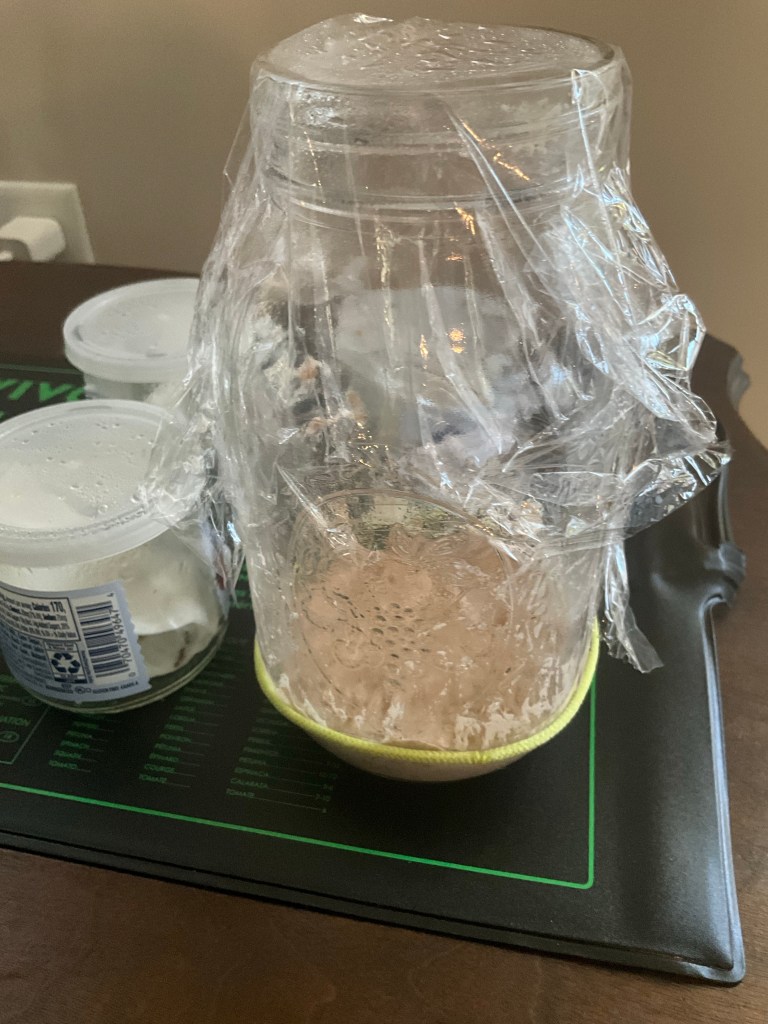
On day 1, I use a large, clean jar. I add 50 grams whole wheat flour, and 50 grams slightly above room temperature, filtered water (I waited till the water in my tea kettle was nearly cold,) Next, I mix these two ingredients with a fork till it becomes pasty. Then I add a rubber band go indicate my level where my starting point is from my starter, and i cover the jar with plastic wrap.
Since the jar now needs to rest for 24 hours and ferment in a warm place, I decided to use my heat mat that I use for my seeds since I am using this for germination right now anyway. Other places would be in the oven with the light on, or on top of the fridge.
Day 2
Time to check for bubbles! On day 2, you may see brown liquid. Do not be alarmed by this stinky stuff, it is called hootch. You can pour it off, or leave it and then wait till tomorrow to discard it with the discard process. You will notice that the mixture will rise and fall throughout the day and it will have some bubbles. As the starter ages, more bubbles will be visible, and the slurry will become thinner.
Day 3 through 7
On day three, you are going to remove half of the mixture and discard it. It is called the discard for this reason. (More about uses for discard below.). After you discard the discard, you are going to feed your starter with 50 of flour, and 50 grams of room temperature filtered water.
Starting on Day four, you are going to take off 2/3 of the mixture, which means, you discard 100 grams and you keep 50. Add 50 grams bread flour and 50 grams filtered water. Follow this process each day till day 10. On day 10, your starter should be ready for use, and you can start baking with it. You can put it in the refrigerator at this point, where you can feed it once a week, or you can keep it at room temperature and continue to feed it daily. The starter will continue to age and the longer you use it, the better it gets! Follow this process each day till day 10. On day 10, your starter should be ready for use, and you can start baking with it. You can put it in the refrigerator at this point, where you can feed it once a week, or you can keep it at room temperature and continue to feed it daily.
Discard
You cannot really use discard for anything the first 10 days, though the second week, you can start saving it up, put it in the fridge, creating a new jar of sourdough starter, and use it in discard recipes. Just realize that the active product is created after feeding your jar and thus the discard, which is the starter that is kind of exhausted, as in done creating carbon dioxide is not good to use as-is as a sourdough starter. When you feed it, and let it process, it becomes a starter in recipes. The discard keeps for about 1 to 2 days at room temperature and about a week in the fridge.
I would make at least one extra jar of starter from one of the discards to keep on hand in case something happens to your mother jar. Also, it is nice to have multiple starters as you can use different types of flour to feed your starter, which will then give you different results when baking.
At this point, I am only on day 1 of my process, so I will be adding additional pictures of my starter as I go through this first week, so check back and refresh this article for the next week or so!
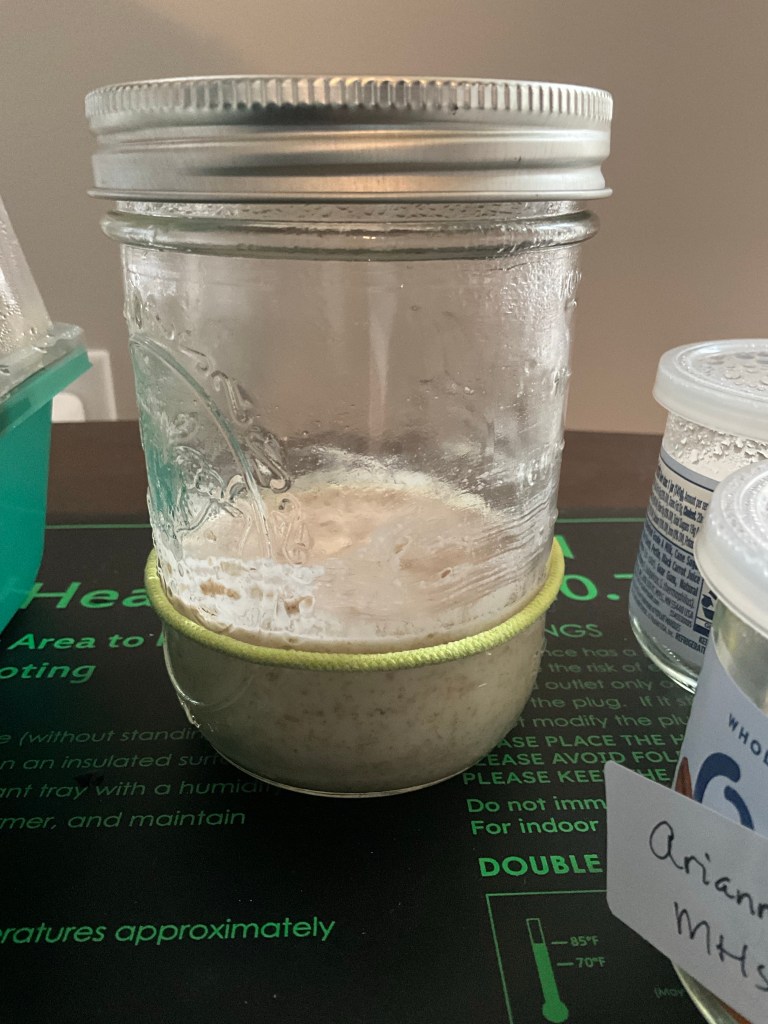
I am at day 5 now, and I am telling you, the jar scents change from sweetish smelling to kinda stinky sour smelling. I saw a little bit of hootch on it, which is taken out whenever it is spotted. The consistency went from thick pasty to like thick pancake batter, it looks right, and it looks like it is coming along. I am mixing 25 grams whole wheat with 25 grams of bread flour as I learned that whole wheat basically provides the bacteria and the bread flour serves as the food source, so we shall see how this ends up as a starter.
 Inga’s Creations